
Thanks Giving or Judgment Giving?

“Who are you to judge another’s servant? To his own master he stands or falls. Indeed, he will be made to stand, for God is able to make him stand.”
— Romans 14:4

Family. There is much wrapped up in the word. As we head this week into Thanksgiving, many will be contemplating all that word entails. I hope and pray you have a wonderful family and enjoy a blessed time together. Yet, many dread the very notion of spending time with family, or at least some of the family—especially that crazy Uncle Warren.

I want to take a moment and pause and consider how judgment comes into this scenario. We all know the history of our family. Who did what. Whose hurt who. Whose unreasonable. Whose abrasive. And we all know how the same old story ends for the hundredth time. With all we know about our family’s history, it is far too easy to pass judgment without much thought.

However, we are warned in the Bible not to judge. Several times, we are told not to pass judgment on others. Romans 14:4 poses the question, “Who are you to judge another’s servant?”

So are we supposed to just ignore history. No! We are to have discernment. In the Christian context, discernment is defined as a “perception in the absence of judgment with a view to obtaining spiritual guidance and understanding.” As 1 Thessalonians 5:21 states, “Test all things; hold fast what is good.”

We are to be wise. We have to protect ourselves and our family by holding fast to what is good for them. This means evaluating which situations we should be in and which we should not. It also means seeing things as they are, not as they used to be.

So, how does this differ from judgment? Judgment is final. Judgment is the conclusion of the trial when the sentence begins. Judgment leaves no room for people to change. It is the concrete shoes on the feet of a relationship dropped to the bottom of a lake.

Yet, God is the business of changing lives. As our verse today continues, “Who are you to judge another’s servant? To his own master he stands or falls. Indeed, he will be made to stand, for God is able to make him stand.” (Romans 14:4) God is able to change the hardest heart. He is able to redeem the lost, raise the dead, heal the brokenhearted, heal the addict, bring joy to the depressed, calm the angry and much, much more. He is life change.

Discernment keeps the door open for change. It neither joins the world in misery nor tears down necessary boundaries. Yet, it allows for change. It hopes for it. It prays for it. It extends the hand of peace.

For many of us, there is one family member we pass judgment on more than any other: ourselves. We can be brutal to the person in the mirror. However, YOU are “another’s servant”: God’s servant. You have no right to even judge yourself! (See 1 Corinthians 4:3-4) Today, are you walking in judgment? Or discernment? Are you open to change? God is able to make you stand!

Here’s some common desires we struggle to find satisfaction for either in ourselves or our family, but in Christ they are satisfied every day. Give thanks that:

You are loved: Jesus said, “As the Father loved Me, I also have loved you; abide in my love.” (John 15:9)

You are accepted: “To the praise of the glory of His grace, by which He made you accepted in the Beloved.” (Ephesians 1:6)

You are forgiven: “And you, being dead in your trespasses and the uncircumcision of your flesh, He has made alive together with Him, having forgiven you all trespasses…” (Colossians 2:13)

You have everything you need for life and godliness: “His divine power has given to us all things that pertain to life and godliness, through the knowledge of Him who called us by glory and virtue.” (2 Peter 1:3)

You are a new creation: “Therefore, if anyone is in Christ, he is a new creation; old things have passed away; behold all things have become new. Now all things are of God, who has reconciled us to Himself through Jesus Christ, and has given us the ministry of reconciliation.”(2 Corinthians 5:17-18)

You are a new creation! God changed you spiritually and wants to work the change out in your life. Which includes your relationships. He longs to work through you as a minister of reconciliation.

I’m challenged this week not to walk in judgment, but in discernment. Finding my desires satisfied in Christ, I’m challenged to leave open the door of hope. To expect change. Change in myself, as I set my eyes on who God says I am. And change in my relationships, by growing as a minister of reconciliation. Real and meaningful change begins with giving thanks for what Christ has done, and ends in earnest expectation that He will bring it to completion!

© 2025 Warren Martin. All rights Reserved.
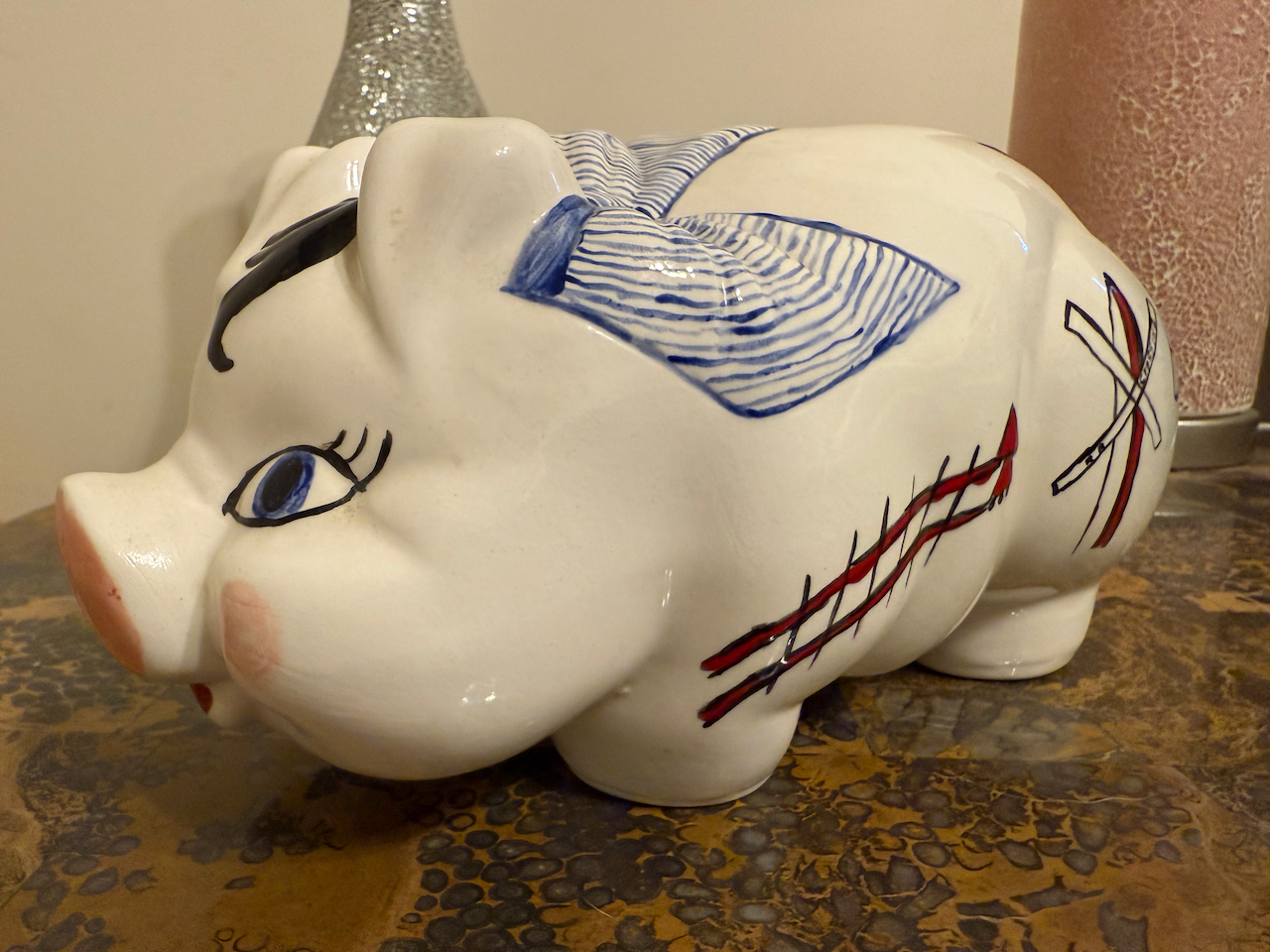
Here, Piggy, Piggy!

“I beseech you therefore, brethren, by the mercies of God, that you present your bodies a living sacrifice, holy, acceptable to God, which is your reasonable service.”
—Romans 12:1

On the shelves in my bedroom I have a piggy bank that belonged to my brother. It was a gift from my Aunt Paula when we were children. She gave me one as well, but it has long since been destroyed, as is the fate of most of my possessions. However, this is one of the few items I have that belonged to my brother who died at 20. So, I cherish it. Many cherish their own piggy bank. It might not be a child’s savings account, but acclaim, self-worth, a bank account, power, luxury, or any number of things.

But why a piggy bank? History shows us it comes from our need to secure our future. For centuries many rural families depended on an actual pig for their financial security. They would acquire a piglet in the spring and feed it on household rubbish throughout the summer and into the fall. In winter, when assets were no longer liquid for commerce, the pig would be their financial security blanket. You could slaughter and eat it, sell it or trade it to survive the winter months.

The pig concept came down through history as a icon of savings. The earliest versions of the “Pig Bank” come from 1900. As an advertisement declared, “The latest novelty — The Pig Bank. You have to kill the pig to get the money — 25¢ each.”

The ad declared the redemption criteria of the piggy bank. It had no stopper to get the money out. This protected the money from theft and encouraged savings. The only way to get the money out was to “kill the pig” and break it to pieces.

The same is true today in our spiritual lives. We seek security. Long for identity. We invest and save up for rainy days when acceptance is lacking. Our pig might be a position of authority, financial security, social acceptance, accomplishment, renown, family, church, or any number of things. We invest in them for the long winter months of scarcity.

Don’t get me wrong. There is nothing wrong with preparing for the future and providing for your family. I’m talking more about how we find our identity in these things. How we try to find a way to establish our own security for the future in and of ourselves. How we seek to establish our own safety net by our own efforts.

It is interesting that the pigs were fed on rubbish. So are we much of the time. The Bible declares pigs to be unclean (Leviticus 11:7-8). This has more to do with the transmission of disease, but it is interesting. How often are we infected with the need to try and establish our own safety net; our own security blanket? How often do we feel alone facing the winter of life and feel we have to find a way to provide for the future on our own. So, we feed our need with rubbish (the things of this world) and hope to make it through.

There comes a time when we have to break the piggy bank! We have to let it shatter upon the floor and realize there is nothing in it that will get us through the winter. As Paul writes in Romans 12:1, “I beseech you therefore, brethren, by the mercies of God, that you present your bodies a living sacrifice, holy, acceptable to God, which is your reasonable service.”

Broken, shattered and alone; we each must come to the Lord. We give up all that we are, for there is nothing there substantial enough to pay the debt we owe. And in exchange, He gives us all He is to balance the debt and grace abounds.

Why do we continue to hoard our assets in piggy banks that will avail us nothing in eternity? Whether it be money, time, effort or any other activity, all is wasted and will be broken to pieces in the trial of winter. The only savings that matters is the treasures we store up in heaven (Matthew 6:20). “For where your treasure is, there your heart will also be.” (Matthew 6:21)

Again, I’m not saying that we shouldn’t be wise with our money, providing for our family and future. I’m talking about our identity. Where do you find your treasure? Are you what you own? Are you what you accomplish? Are you the position you hold? Are you defined by the relationships you have with others? Are you…fill in the blank?

Or are you defined by who Christ says you are? What He has done? Who He has called you to be?

I’m challenged this week to evaluate where I am storing up my treasure. Is it in my own efforts? For my own comfort? Or is it in who Christ has called me to be?

I believe I need to break a few piggy banks in my life. Let go of the security blanket I’m trying to create for myself and trust His plan. Invest in heavenly treasures. Sacrifice who I want to be in order to be who He called me to be.

I don’t need a spiritual piggy bank! I have a trust fund. “Trust in the Lord with all your heart, And lean not on your own understanding; In all your ways acknowledge Him, And He shall direct your paths.” (Proverbs 3:5-6)

© 2025 Warren Martin. All rights Reserved.

A Commonplace Pearl

“Again, the kingdom of heaven is like a merchant seeking beautiful pearls, who, when he had found one pearl of great price, went and sold all that he had and bought it.”
—Matthew 13:45-46

Dear Christian, you are God’s favorite child! Period. But, most of us have made it commonplace.

The term ‘commonplace’ has come down to us today as meaning “a usual or ordinary thing”. However, you know me and how much I love history; there is a story here. The word ‘commonplace’ comes from the emerging usage of notebooks. More specifically it originates with the production of paper in Europe during the Renaissance.

As paper became more accessible, people began making more notes and notebooks. One such creation was Commonplace Books. During the Renaissance and after, people would jot down snippets of knowledge in a commonplace. It was a way to consolidate knowledge (quotes, poems, verses, etc.) into categories readily accessible to the reader. However, over time, these snippets began to be regarded as trivial. In other words, people wrote down wise thoughts, but did not own them nor live them. They began to be seen as tripe knowledge, where the beholder of such was no better off despite the wisdom they held.

Thus, today, commonplace refers to something ordinary.

One of the earliest usages of Commonplace Books was in the collection of Biblical verses around a topic. I will provide an example here. If you assimilate just a few of the verses about who you are as a child of God you will find…

In Christ you are:

Chosen by God - John 15:16
A Child of God - John 1:12-13
Completely forgiven - Colossians 2:13
Totally loved - 1 John 4:16
Righteous - 2 Corinthians 5:21
Accepted in His sight - Ephesians 1:6
Holy and without blame - Ephesians 1:4
Created for good works - Ephesians 2:10

And these are just a few of the verses that could be in your commonplace notebook. However, rather than understanding them and the magnitude of how they impact our life, we have made them commonplace in the modern understanding of the word. It’s just an ordinary thing Christians say.

How tragic! Do you not understand that you are in Christ! He is in you! You are a partaker of the divine nature (2 Peter 1:4). Christ was the pearl of great worth, for which we sold everything to acquire! How much more are we the prodigal child that He runs to embrace and celebrate for we once were dead and now are alive again? (Luke 15:32)

I’m an challenged this week with the commonplace ideas I hold onto. I’m challenged to consider them anew. I’m challenged to never consider them as ordinary, but to understand how truly significant they are in my life. I acquired the pearl of great price (Christ), and in doing so, I have become a person of great wealth. I am a “new creation; old things have passed away; behold, all things have become new.” (2 Corinthians 5:17)

There is nothing you can do to make God love you more. There is nothing you can do to make God love you less. You are who you are in Christ because He has made you so. It is all about Him, not you.

I challenge you: has the commonplace of God’s truth become “commonplace” in your life? Have you allowed all that you know about your relationship with Him to become ordinary? Or are you willing to join me this week in experiencing the extraordinary person He called you to be? Nothing is more extraordinary. You are His favorite child! Be ALL He created you to be!

© 2025 Warren Martin. All rights Reserved.

Swing Away!

“Sacrifice and offering You did not desire; My ears You have opened…I delight to do Your will, O my God, And Your law is within my heart.”
— Psalm 40:6-8

Have you ever seen a man hop around on one foot and howl like a maniac while grasping his butt cheeks? I have, and I laughed.

When I was a youth minister, we had returned home from a retreat and were unloading the trailer. I picked up a wooden boat oar and pretended to smack Brian (an adult counselor) in mock slow motion. In response, Brian laughed, stuck out his butt and said, “Go ahead. Give it your best shot.” To which, I did. I lit him up. I held nothing back. Don’t give me a shot, because I will swing away! In that moment I was only thinking about myself, not his pain.

A few days later, his wife informed me that he had a bruise from his belt line down to the middle of his thigh. I’ve never been afraid to take a shot. I do feel bad every time I chuckle at the memory. But he gave me permission. Right?!

We often forget that permission does not equate profitability. Paul wrote in 1 Corinthians 6:12, “All things are lawful for me, but not all things are helpful; all things are lawful for me, but not all things edify.” I had permission, but I don’t think my actions benefited anyone.

In the Old Testament, the Israelites had permission to be governed by an earthly king. God warned them about the consequences, but they chose a king anyway. God told the prophet Samuel, “Heed the voice of the people in all that they say to you, for they have not rejected you, but they have rejected Me, that I should not reign over them.” (1 Samuel 8:7)

Even then, God chose the best of men to be their king. He was everything you could want in a king and he was a man of faith. When it came time to anoint Saul king, Samuel looked everywhere for him in the crowd, but he wasn’t there. They searched for him, but couldn’t find him. The Lord spoke to Samuel and said, “There he is, hidden among the equipment.” (1 Samuel 10:22).

Saul knew he was going to be made king, but it terrified him. He felt unworthy and unqualified. And he was, until the “Spirit of God came upon Saul.” (1 Samuel 11:6) Then he swung away! He put everything into his work as king and defeated the Ammonites.

If you know the story, then you know the next four chapters did not go well for Saul. He got tired of waiting for the Lord’s prophet to show up and made an unlawful sacrifice before a battle. He built a monument to himself, and broke God’s command in the battle against Amalek. His justification was that the king and animals he kept alive would be a sacrifice to the Lord.

As a consequence, God rejected Saul as king of Israel. Samuel asked Saul, “When you were little in your own eyes, were you not head of the tribes of Israel?” (1 Samuel 15:17) In other words, when you were hiding in the equipment hadn’t God already made you king? But now you think it is about you instead of God. So, God has removed you as king. Samuel concluded with, “Behold, to obey is better than sacrifice.” (1 Samuel 15:22).

It is not possible to have obedience without being dependent on the Lord.

What is amazing about this story is God replaced Saul with a king “after His own heart”: David. He messed up every bit as much as Saul did. What was the difference? Simple, David never forgot he was just a man and God is God! Both men were the type that would swing away with all they had when given a chance. Saul forgot his place thinking periodic sacrifices would be enough. David, even through all his sins, never forgot who was Lord!

I’m astonished by the number of people paralyzed by their past. They feel disqualified to join God in His work. They hide in the equipment hoping not to be discovered. That is where Saul was at his best! It was the one moment when his kingship was all about God. Similarly, Paul relates the Lord’s response to his own weakness in 2 Corinthians 12:9, “My grace is sufficient for you, for My strength is made perfect in weakness.”

We were put on this earth to swing away! Swing for the fence! Give it all we’ve got. Yet, while everything is permissible, not everything is profitable. It is not about our activity, because it is not about us. It is all about Christ. It is all about joining Him in His work, that only He can bring to completion.

It is easy to start thinking it is all about ourselves. That thinking only ends one of two ways; paralyzed by guilt or blinded by pride (which inevitably leads to the fall). It is not about giving God His due, as sacrifice is not His desire. It is about knowing Him, His law written on your heart, and being obedient to who He called you to be: a child that is completely dependent on Him in every moment.

Understanding we are completely dependent on Him empowers our lives. It enables us to come out of hiding, face our past, forgive, love and swing away! Go for it, trusting it is all about Him and not about us. We are going to mess up. We are going to get it wrong. Yet, if we always move forward understanding it is all dependent on Him and not us, we are able to say with David (the man after God’s own heart), “Sacrifice and offering You did not desire; My ears You have opened…I delight to do Your will, O my God, And Your law is within my heart.”

Swing away! Go for the fences! Light it up! Just understand everything is dependent on Jesus and He is able to speak, work and live through you in this moment. Will you let Him? Batter up!

© 2025 Warren Martin. All rights Reserved.

A Woman Shall Encompass a Man

“How long will you gad about, O you backsliding daughter? For the Lord has created a new thing on the earth — A woman shall encompass a man.”
— Jeremiah 31:22

It is rare in today’s world to find a verse in the Bible where interpretations are so disagreed upon as that of this verse. Early Biblical theologians attributed this verse to the coming of the virgin Mary, but the vast majority of theologians today discredit that interpretation. I’m no theologian. I’m just a man who reads the Bible and shares what I find in its words. So, here is my opinion… and you know what they say about opinions.

I’m the worst planner in the history of mankind. I’ll never forget the day I proposed to Wendy. Most men fret over this day, plan, find a romantic spot, get people to witness and film, but, unfortunately for Wendy, she did not find such a man.

We were sitting on the couch in her parents’ living room watching TV. I was laying down with my head in her lap. I asked her, “Have you ever thought about getting married?”

She responded with something along the lines of, “Yes, but I want to finish college first. Maybe go to California and try acting or something. Then, maybe, I’ll be ready for marriage.”

I listened, hesitated, then said, “You want to get married?”

She instantly responded, “Yep, sure do!”

Then, the thought hit me, I had better figure out how to get a ring.

I took a job green-breaking horses, mending fence and building roping dummies for Edd Farabee just outside of Levelland, TX. He was a stern man. His wife often had breakfast, lunch or even dinner ready so we could keep working. He was a fair man. More than that, he was generous. He gave me the money to buy the ring and let me work it off. He also tremendously impacted my life and character.

I think about this story often. My wife deserved better. She deserved more planning, consideration, romance… just more! Instead she got me.

The Bible often refers to believers as the bride of Christ. He was a much better planner than me. He loved us. He pursued us into the darkest regions of the world. He had a plan. That plan led to Him laying down His life on the cross. It included descending into hell, rising again and offering the engagement ring of life to all.

For most men (and, in today’s world, sometimes women), that is the scariest moment of their entire life. That eternal moment after “popping” the question and waiting for the answer. It feels as if everything in life is determined by that moment. All the chips are pushed to the center of the table. We are all in and have no control over what comes next.

I believe this is the moment of Jeremiah 31:22. The passage is a prophecy verse of what is to come. It anticipates all the preparations and workings of Christ in order to issue the proposal to His bride of eternal life. Throughout all of the Old Testament God chose His people. He made the decision. However, under the New Covenant, He created “a new thing on the earth.” The death and resurrection of Christ was a proposal to His hopeful bride, but we would have to choose Him.

Make no mistake, Christ awaits in earnest expectation of your answer. All of His love is focused on you. Everything He has done has been for you. He planned the perfect moment. He paid up front for everything. He is offering everything He is to you. And He awaits your response.

He awaits for the woman to encompass the man! For you to accept Him, accept His life into yours, and to come alive with His presence in your life. For everything you are to be built around Him. He awaits for you to accept Him and become His bride.

If you have not made this decision, know He eagerly awaits. His love is true. And reach out to me or someone you trust to share in this moment.

Maybe you already have done this, but don’t miss the word “encompass”. It means to completely surround. It is the idea of every aspect of your life revolving around Him. He is not calling us to walk hand-in-hand. He is calling us to allow Him to live through every aspect of our lives.

Sometimes, I feel as if I’m walking this road still trying to pay off the cost of the engagement ring. I fail to see that Jesus has already paid for it all. The only thing left for me to give is myself. I’ll be honest, it is scary to give all. I want to see how the relationship works out first. But it doesn’t work, unless I give all. Everything I am in exchange for everything He is!

I’m challenged with identifying what I’m holding back? Will I, as a bride of Christ, encompass the man? Allow everything in my life to revolve around Him? I know He earnestly, patiently and lovingly awaits my response in this moment. How will I respond? How will you?

© 2025 Warren Martin. All rights Reserved.